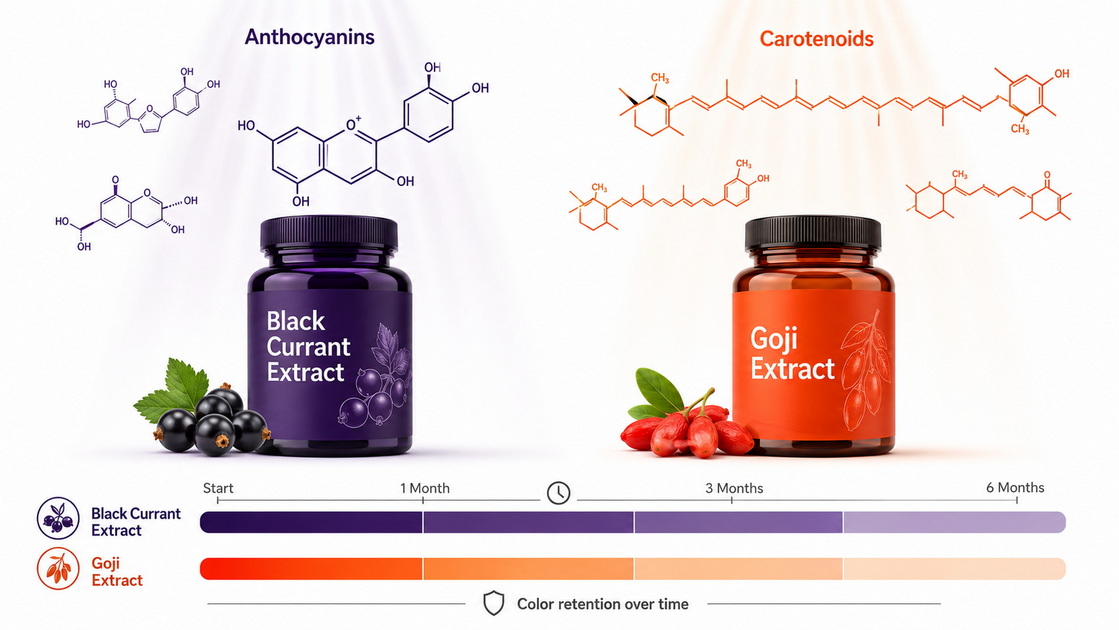
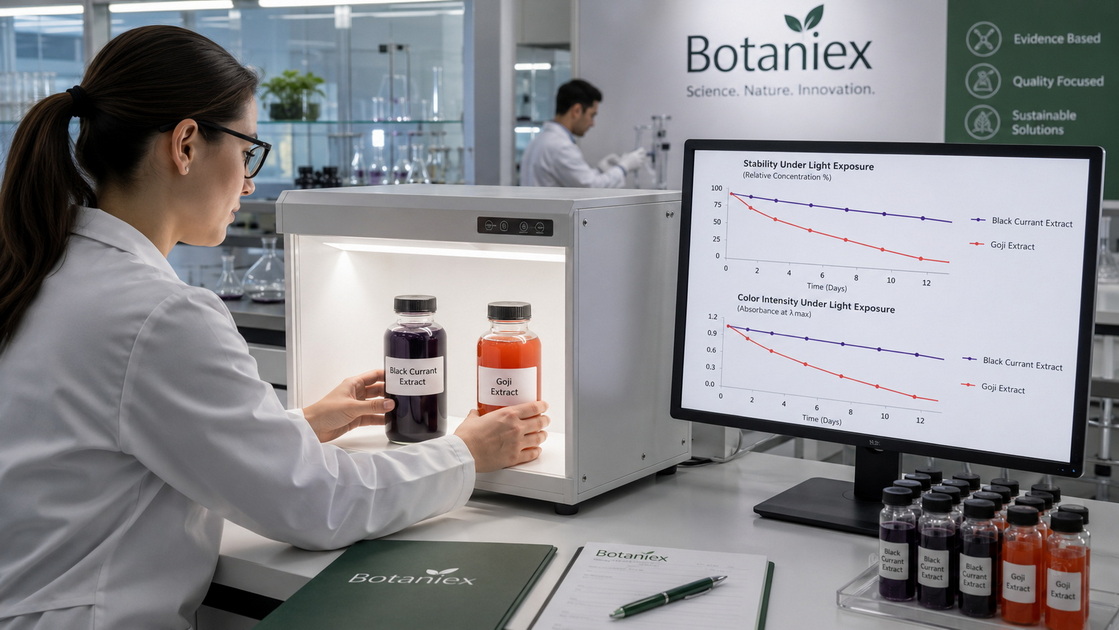
Black currant extract generally offers stronger, more predictable light stability for color-critical applications than standard wolfberry/goji extract, but optimized goji formulations can perform well in opaque or semi-opaque systems. For a manufacturer like Botaniex, this creates two distinct development pathways: anthocyanin‑driven color performance (black currant) versus carotenoid‑ and polysaccharide‑driven functionality (goji) with managed light exposure. [botaniex]
Understanding Light Stability In Botanical Extracts
Light stability describes how well an extract's key actives and color pigments resist degradation when exposed to light over time. In real-world products, poor light stability leads to color fading, off-flavors, potency loss, and consumer distrust. [academia]
For polyphenol‑rich berries like black currant, photodegradation mostly affects anthocyanins, while in goji it primarily affects carotenoids such as zeaxanthin and β‑carotene, as well as some sensitive phenolics. From a formulation standpoint, light stability is not just a chemical property but a design variable that can be engineered via solvent system, pH, co‑ingredients, packaging, and processing. [sciencedirect]
Botaniex's Position: Science‑Led Light Stability
As a botanical extract manufacturer serving dietary supplement, functional food, beverage, cosmetic, and pharmaceutical brands, Botaniex operates at the intersection of plant chemistry and industrial process engineering. This makes light stability a core quality dimension, not a secondary specification. [exportpages]
Internally, a supplier like Botaniex can:
- Design tailored extraction parameters (solvent, temperature, time, pH) to prioritize pigment integrity.
- Apply post‑extraction stabilization strategies (copigmentation, encapsulation, controlled drying, antioxidant systems) that directly impact photostability. [pmc.ncbi.nlm.nih]
From my perspective as an industry formulator, the key value of working with Botaniex is not just buying "black currant extract" or "goji extract", but specifying light‑stability targets upfront and letting the R&D team engineer the extract around those requirements.
Black Currant Extract: Anthocyanin‑Driven Light Stability
Anthocyanin profile and its relevance
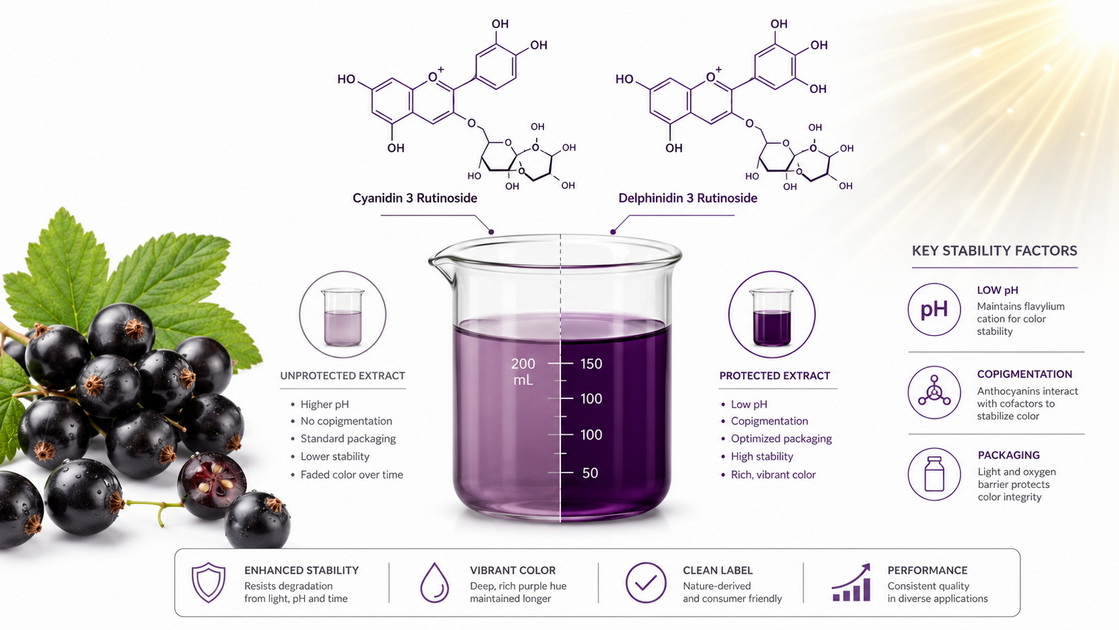
Black currant (Ribes nigrum) is naturally rich in anthocyanins, predominantly delphinidin‑ and cyanidin‑rutinosides, along with other polyphenols. These molecules give the deep purple‑black color and are responsible for much of the extract's antioxidant capacity. [sciencedirect]
Studies show that anthocyanin content and composition strongly influence light and storage stability; specific anthocyanins such as cyanidin‑3‑rutinoside are more stable under thermal and light stress than others. For brands that rely on a consistent purple hue in beverages, gummies, or capsules, this molecular profile is a major advantage. [academia]
Light stability behavior in real products
Experimental work on black currant anthocyanins shows:
- Significant light sensitivity in aqueous solutions, with up to roughly 35–57% pigment loss under strong light exposure depending on matrix and conditions. [sciencedirect]
- Improved color and activity stability when anthocyanins are involved in copigmentation with phenolic acids like chlorogenic or ferulic acid, which form non‑covalent complexes that protect pigments and enhance color intensity. [pmc.ncbi.nlm.nih]
- Better performance at low pH and under refrigerated storage, especially when oxygen and metal ions are controlled. [pmc.ncbi.nlm.nih]
In practice, well‑designed black currant extracts can maintain acceptable color and activity through shelf life in:
- Acidic ready‑to‑drink beverages stored in light‑protected PET or glass.
- Softgels and capsules where the fill matrix and shell provide additional light barriers.
- Cosmetic serums packed in amber or airless packaging, where the extract's antioxidant function is synergistic with other actives. [sciencedirect]
Where black currant excels
From a product development viewpoint, I recommend black currant extract when:
- You need a strong, stable purple‑to‑deep‑red color as a key part of product identity.
- The product will be exposed to light during display or use, such as beverages in transparent bottles.
- You want to combine color with antioxidant positioning, especially in sports nutrition, cardiovascular, or eye‑health‑adjacent concepts. [pmc.ncbi.nlm.nih]
Wolfberry/Goji Extract: Carotenoid and Polysaccharide Light Pathways
Composition profile: carotenoids and polysaccharides
Standard goji berry (*Lycium barbarum*) extracts are chemically different from black currant. They typically feature: [atamanchemicals]
- Polysaccharides (5–8% in dried fruits), which drive many of goji's immunomodulatory and anti‑aging claims. [academic.oup]
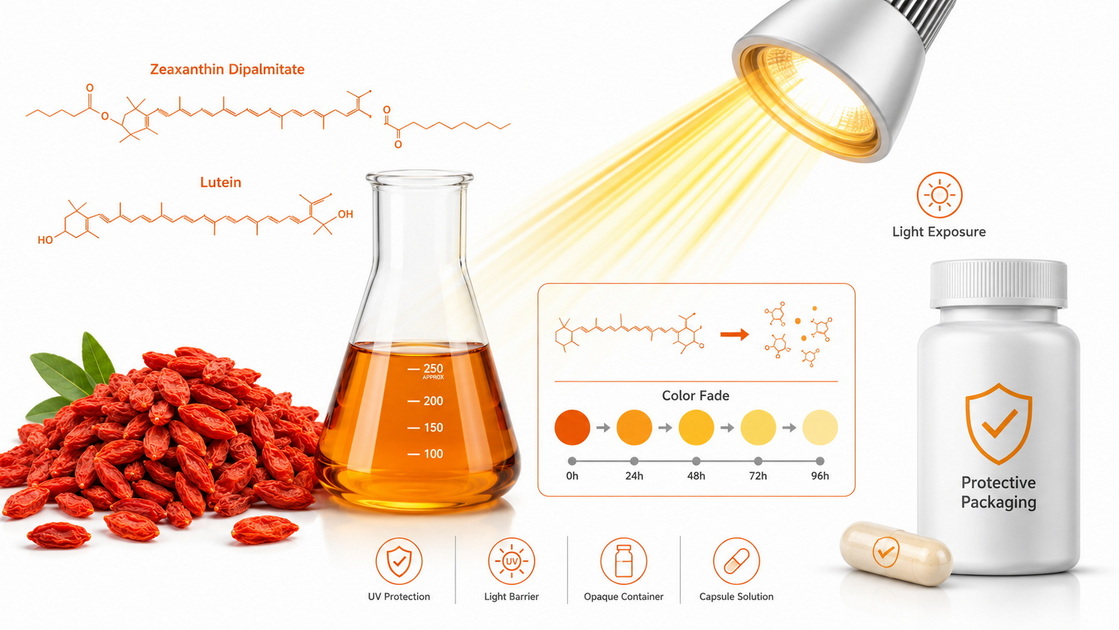
- Carotenoids, notably zeaxanthin dipalmitate, zeaxanthin, and lutein, which contribute to the orange‑red color and ocular health positioning. [sciencedirect]
- Flavonoids and other phenolics, which support antioxidant and anti‑inflammatory effects. [atamanchemicals]
From a light stability standpoint, the critical difference is that carotenoids are highly conjugated molecules prone to photo‑oxidation, particularly in the presence of oxygen and light. [sciencedirect]
Light stability behavior of goji components
While comprehensive photostability data for standard goji extracts is less abundant than for black currant, existing literature and carotenoid chemistry suggest:
- Carotenoids degrade under light, especially in oxygen‑rich and high‑temperature environments, leading to color fading and loss of bioactivity. [sciencedirect]
- Goji polysaccharides are relatively robust under light exposure, especially in dry or encapsulated forms, so their functional claims are less vulnerable than the color. [academic.oup]
- In cosmetic applications, goji fruit extracts can still deliver anti‑aging and antioxidant benefits when incorporated at suitable levels and protected with appropriate packaging and formulation (antioxidant co‑systems, emulsions, opaque or tinted containers). [atamanchemicals]
Where goji extract fits best
From a formulation and brand perspective, I see goji extract as the better option when:
- Color is secondary and the primary focus is immune, anti‑aging, or eye‑health positioning driven by polysaccharides and carotenoids.
- Products are naturally protected from light, e.g., tablets in opaque blisters, capsules in solid bottles, or creams in airless pumps.
- The brand narrative emphasizes traditional, TCM‑inspired wellness rather than intense berry color.
Head‑to‑Head: Light Stability Comparison
Light Stability Pathways: Black Currant Extract vs. Goji Extract
| Dimension | Black Currant Extract | Wolfberry/Goji Extract |
| Dominant pigments | Anthocyanins (delphinidin, cyanidin rutinosides) sciencedirect | Carotenoids (zeaxanthin dipalmitate, zeaxanthin, lutein) plus polysaccharides atamanchemicals |
| Main light‑sensitive components | Anthocyanins (color and antioxidant activity) academia | Carotenoids (color and eye‑health function) academic.oup |
| Photostability profile | Sensitive to light but can be significantly stabilized via low pH, copigmentation, and packaging; good performance in optimized systems. pmc.ncbi.nlm.nih | Carotenoids prone to photo‑oxidation; polysaccharides relatively robust; stability strongly depends on light‑protected packaging. academic.oup |
| Ideal product formats | Acidic beverages, gummies, softgels, cosmetic serums with protected packaging. sciencedirect | Capsules, tablets, powders, creams in opaque containers where color is less critical. atamanchemicals |
| Sensory/color impact over shelf life | Better retention of deep purple color under managed conditions. pmc.ncbi.nlm.nih | Orange‑red color may fade faster under light, especially in transparent systems. academic.oup |
| Regulatory/label appeal | Strong "natural colorant" and "rich in anthocyanins" story. sciencedirect | Strong "goji polysaccharides" and "zeaxanthin for eye health" narrative. atamanchemicals |
From my own development work, black currant is the safer choice when your packaging or retail environment cannot fully control light exposure, whereas goji works best when you can design robust light barriers into the packaging and dosage form from day one.
Expert‑Level Strategies To Improve Light Stability
1. Extraction and standardization choices
A manufacturer like Botaniex can tune light stability at the extraction stage by:
- Selecting solvent systems that favor stable pigment forms (e.g., acidified hydroalcoholic systems for anthocyanins, controlled polarity for carotenoids). [pmc.ncbi.nlm.nih]
- Adjusting temperature and time to balance yield and pigment integrity.
- Standardizing to specific markers (e.g., total anthocyanins for black currant, polysaccharides and zeaxanthin for goji) to ensure consistent behavior across batches. [pmc.ncbi.nlm.nih]
In my experience, clear marker specifications and stability targets agreed up front with the supplier dramatically reduce reformulation loops later.
2. Copigmentation and antioxidant systems
For black currant anthocyanins, copigmentation with phenolic acids (such as chlorogenic or ferulic acid) can notably improve half‑life and color retention under light. You get both enhanced color intensity and slower degradation. [pmc.ncbi.nlm.nih]
For goji carotenoids, co‑formulation with lipid‑soluble antioxidants (e.g., tocopherols) and chelating agents helps mitigate photo‑oxidation. Integrating these systems into the extract or premix streamlines downstream formulation. [sciencedirect]
3. Encapsulation and delivery forms
Across both extracts, encapsulation is a powerful tool:
- Spray‑dried powders with carriers can shield pigments from direct light and oxygen, suitable for powders, gummies, and dry beverage mixes. [sciencedirect]
- Liposomal or microencapsulated systems (especially relevant for carotenoid‑rich goji extracts) can boost bioavailability and protect against photodegradation. [sciencedirect]
When I evaluate a supplier, I specifically look for whether they can offer ready‑to‑use encapsulated grades for light‑exposed formats.
Practical Development Pathways For Different Applications
For functional beverages
- Primary recommendation: black currant extract, standardized to anthocyanins and formulated at low pH. [sciencedirect]
- Key light‑stability actions:
1. Use acidic matrices (pH 2.5–3.5) to favor stable anthocyanin forms. [academia]
2. Incorporate copigments (e.g., chlorogenic acid) to improve color retention. [pmc.ncbi.nlm.nih]
3. Choose UV‑blocking or tinted PET/glass, and minimize headspace oxygen.
Goji can still be used as a supporting ingredient for eye‑health or immune claims, but I would not rely on it as the primary colorant in light‑exposed drinks.
For dietary supplements (capsules, tablets)
- For eye‑health formulations: goji extract standardized to polysaccharides and carotenoids is a strong choice, provided capsules or tablets are packed in opaque bottles or blisters. [academic.oup]
- For antioxidant blends with visual differentiation: combine black currant (for color and anthocyanins) with goji (for polysaccharides and zeaxanthin) inside capsules where light exposure is minimal.
Here, light stability is driven more by primary packaging design than by the extract alone, but choosing encapsulated or stabilized grades from Botaniex adds an extra safety layer.
For cosmetics and dermo‑nutrition
- Black currant works well in serums and creams where antioxidant claims and a subtle purple hue are desired, as long as the formulation is pH‑appropriate and packed in light‑protective containers. [pmc.ncbi.nlm.nih]
- Goji is attractive for anti‑aging and "radiance" narratives; carotenoids and polysaccharides contribute to skin benefits but require careful protection from light and oxygen. [atamanchemicals]
Step‑By‑Step Light Stability Checklist For R&D Teams
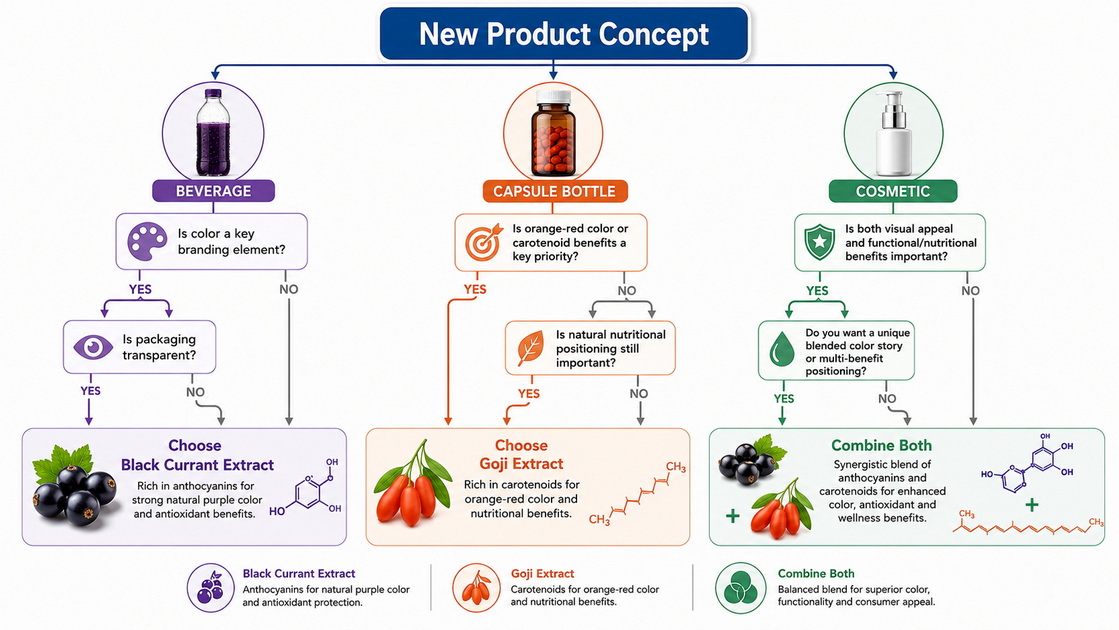
From a practical R&D perspective, this is the process I recommend when choosing between black currant and goji extract for light‑exposed products:
1. Define the role of color.
- Is color a primary branding element? If yes, bias toward black currant.
2. Map anticipated light exposure.
- Retail lighting, transparent vs. opaque packaging, consumer use patterns.
3. Select the extract type and grade.
- For high‑light beverages: black currant, anthocyanin‑standardized, possibly spray‑dried.
- For capsules/opaque formats: goji, polysaccharide/carotenoid‑standardized.
4. Engineer the formulation environment.
- pH, presence of copigments or antioxidants, metal chelators, oxygen control.
5. Run side‑by‑side stability tests.
- Compare color, key marker content, and sensory profile over time under accelerated light conditions; work with Botaniex's technical team for protocol design. [sciencedirect]
6. Use data to refine specifications.
- Lock in minimum anthocyanin/polysaccharide/carotenoid levels and acceptable color change thresholds in your ingredient specifications and supply agreements.
How Botaniex Can Add E‑E‑A‑T Value
From an E‑E‑A‑T (Experience, Expertise, Authoritativeness, Trustworthiness) perspective, Botaniex can strengthen partners' product stories around light stability in several ways:
- Experience: Years of manufacturing natural ingredients for diverse industries means real‑world insight into how black currant and goji behave across dosage forms and geographies. [botaniex]
- Expertise: In‑house R&D teams that understand anthocyanin and carotenoid chemistry can propose application‑specific extract grades and stabilization systems. [shippingonline]
- Authoritativeness: Publication of technical sheets, white papers, and stability data (under NDA when needed) positions Botaniex as a knowledge partner, not just a commodity supplier.
- Trustworthiness: Traceable sourcing, quality certifications (e.g., ISO, GMP, HACCP), and consistent batch performance underpin any claims made about light stability. [botaniex.en.made-in-china]
For brand owners, referencing supplier‑backed data in marketing and regulatory dossiers makes light‑stability claims more credible and defensible.
CTA: Co‑Design A Light‑Stable Berry System With Botaniex
If your team is developing a new light‑exposed beverage, supplement, or cosmetic and needs to choose between black currant and goji extract, the most efficient route is to co‑design the solution with Botaniex's R&D and applications specialists. [exportpages]
Share your:
- Target dosage form and packaging,
- Desired color and positioning (eye health, antioxidant, anti‑aging, etc.),
- Required shelf life and storage conditions,
and request a side‑by‑side prototype set using both black currant and goji‑based systems. This data‑driven approach will clarify which extract – or which combination – offers the best light stability–to–cost–to–story ratio for your brand.
FAQ
1. Is black currant extract always more light‑stable than goji extract?
Not always, but black currant typically offers more controllable light stability in color‑driven, acidic applications, especially when copigmentation and protective packaging are used. Goji can perform well when encapsulated and protected from light, particularly in opaque dosage forms. [academia]
2. Can I combine black currant and goji extract in one formulation?
Yes. Many formulators combine black currant for color and anthocyanins with goji for polysaccharides and carotenoids, as long as the matrix and packaging adequately protect both pigment types. Stability testing is essential before launch. [sciencedirect]
3. How important is packaging for light stability compared to extract choice?
Both matter, but packaging can make or break real‑world stability. Even a well‑stabilized extract will degrade quickly in clear, oxygen‑permeable packaging under intense lighting. Conversely, robust packaging can compensate for moderately sensitive pigments. [academia]
4. Are there regulatory differences between using black currant and goji extracts as colorants?
Regulatory status depends on market and extract type, but black currant anthocyanins are widely recognized as natural color sources, while goji is more often positioned for its functional components. Always confirm local regulations for colorant and nutraceutical use. [academic.oup]
5. What data should I request from a supplier when comparing light stability?
Ask for: marker content specs (anthocyanins, polysaccharides, carotenoids), accelerated light and storage stability data, recommended use levels and pH ranges, and any case studies in similar applications. This will help you benchmark options objectively. [pmc.ncbi.nlm.nih]
References
1. Botaniex – Company overview and product portfolio. [botaniex]
https://www.botaniex.com
2. Exportpages – Botaniex profile as an innovative natural ingredient manufacturer. [exportpages]
https://exportpages.com/comp/152130
3. Impact of various factors on the composition and stability of black currant anthocyanins (scientific article). [sciencedirect]
https://www.academia.edu/18322955/Impact_of_various_factors_on_the_composition_and_stability_of_black_currant_anthocyanins
4. Stability enhancement of anthocyanins from blackcurrant through copigmentation. [pmc.ncbi.nlm.nih]
https://pmc.ncbi.nlm.nih.gov/articles/PMC9457548/
5. Stability of anthocyanins from commercial black currant juice. [pmc.ncbi.nlm.nih]
https://pmc.ncbi.nlm.nih.gov/articles/PMC5694678/
6. Application, emerging health benefits, and dosage effects of blackcurrant polyphenols. [sciencedirect]
https://www.sciencedirect.com/science/article/pii/S1756464622002171
7. Goji berries: review of bioactive components and health benefits. [academic.oup]
https://academic.oup.com/ijfst/article/60/2/vvaf232/8341467
8. Ataman Chemical – Goji berry extract composition and cosmetic usage. [atamanchemicals]
https://www.atamanchemicals.com/goji-berry-lycium-chinense-extract_u30947/
9. Carotenoids present in goji berries and their suitability as bioavailable nutrients. [sciencedirect]
https://www.sciencedirect.com/science/article/pii/S1756464622001190
10. Black goji berry anthocyanins: extraction, stability, and applications. [pubs.acs]
https://pubs.acs.org/doi/10.1021/acsfoodscitech.1c00203