Sourcing bulk botanical extracts requires more than finding a supplier with an attractive price. For dietary supplement brands, functional food and beverage manufacturers, cosmetics companies, and ingredient distributors, successful procurement depends on product specifications, quality documentation, supply reliability, and suitability for the intended application.
Whether you are purchasing a standardized herbal extract for an established product or sourcing botanical ingredients for a new formulation, a structured procurement process can help reduce quality risks, improve supplier communication, and support long-term supply planning.
This guide explains what buyers should consider when sourcing bulk botanical extracts, from defining product requirements to reviewing documentation, comparing quotations, and preparing for commercial orders.
1. What Are Bulk Botanical Extracts?
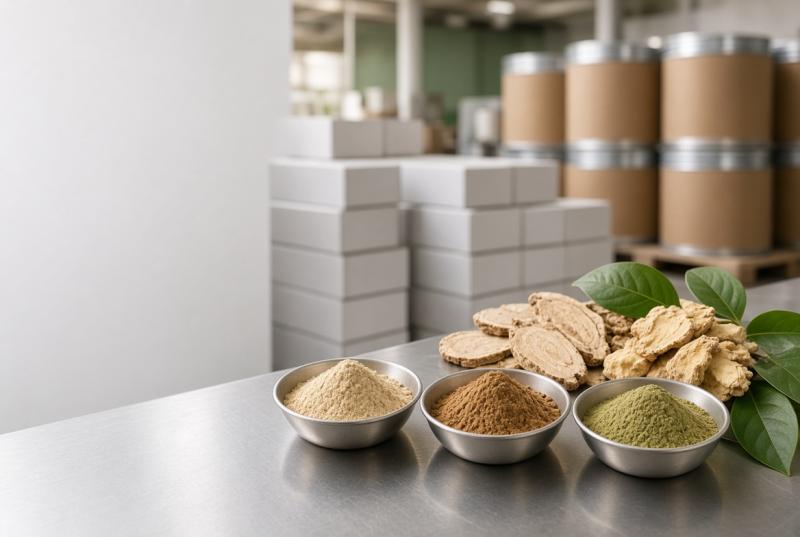
Bulk botanical extracts are plant-derived ingredients supplied in quantities intended for commercial manufacturing, formulation development, or distribution rather than individual consumer use.
Depending on the botanical material and processing method, extracts may be available in powder, liquid, or other forms. They may be used in dietary supplements, functional foods, beverages, cosmetics, and other applications, subject to the ingredient's characteristics and applicable regulations.
Common product categories include:
· Herbal extracts, such as ginseng, ginger, and maca extracts
· Standardized botanical extracts with specified marker compounds
· Mushroom extracts, depending on species and product specifications
· Botanical extracts developed for particular formulation requirements
· Customized botanical ingredients produced to agreed specifications
The term "bulk" describes the intended supply quantity or commercial purchasing format. It does not, by itself, indicate a particular purity level, extract ratio, quality grade, or manufacturing standard.
Buyers should therefore evaluate each product against its actual specification and intended use.
2. Define Your Product Specifications Before Requesting a Quote
Clear specifications help suppliers determine whether they can offer a suitable product and prepare a meaningful quotation.
Before requesting prices, identify the following parameters.
Botanical Identity
Specify the botanical's common name and scientific name whenever possible. Also identify the plant part used, such as the root, leaf, fruit, bark, or mushroom fruiting body, as applicable.
Scientific identification is important because products sold under similar common names may differ in species, composition, or intended application.
Extract Form and Ratio
Confirm whether you require a powder extract, liquid extract, or another form.
If an extract ratio is relevant, specify the required ratio and the basis on which it is calculated. For example, a stated 10:1 ratio should be interpreted according to the supplier's documented definition and manufacturing basis.
Extract ratios should not be used alone to determine product quality or active compound concentration.
Standardized Active Compounds
For standardized extracts, define the target marker compound and required content where appropriate.
Examples include ginsenosides in certain ginseng extracts and eurycomanone in specified Tongkat Ali extracts.
Ask how the marker is measured and which analytical method is used. Two products reporting similar marker percentages may not be directly comparable if their analytical methods, definitions, or specifications differ.
Physical and Application Requirements
Depending on the application, relevant parameters may include:
· Powder or liquid form
· Particle size
· Water solubility or dispersibility
· Moisture content
· Color, odor, and appearance
· Carrier ingredients or excipients
· Bulk density or other handling characteristics
· Compatibility with the intended formulation
Not every parameter applies to every botanical extract. Select requirements according to the actual manufacturing process and finished product.
3. Evaluate Quality Documentation
Quality documentation is an essential part of bulk botanical ingredient procurement. It helps buyers determine whether the offered material meets the requirements established for their project.
Common documents to request include:
Product Specification Sheet
Describes the product's defined identity, quality parameters, acceptance limits, and other relevant characteristics.
Certificate of Analysis (COA)
Reports analytical results for a particular batch against applicable specifications. Review the batch number, test results, units, acceptance criteria, and analytical methods where provided.
Botanical Identity Information
Supports confirmation of the plant species and relevant plant part. Depending on the ingredient, identification may involve documentary, macroscopic, microscopic, chemical, or other appropriate methods.
Contaminant Testing Information
Depending on the intended application and destination market, buyers may need evidence relating to heavy metals, microbiological parameters, pesticide residues, residual solvents, or other relevant contaminants.
Safety and Handling Information
May include storage conditions, handling precautions, safety documentation, and shelf-life information.
Certification Documents
Where relevant, request current certificates and verify their scope, validity, issuing body, and applicability to the product or facility.
Documentation requirements vary by ingredient, application, and market. A supplier should not be assumed to meet every requirement simply because it can provide a COA or holds a particular certification.
4. Understand the Difference Between Extract Ratio and Standardization
Extract ratio and active marker content are related to different aspects of an ingredient's specification.
An extract ratio generally describes the relationship between the quantity of starting botanical material and the resulting extract on a stated basis. The exact interpretation depends on the supplier's definition and manufacturing process.
Standardization refers to controlling or specifying the content of one or more selected compounds or marker constituents.
For example, two botanical extracts may both be described as 10:1 but have different marker compound concentrations. Conversely, two extracts with the same stated marker percentage may differ in extract ratio, composition, or other quality parameters.
When comparing bulk botanical extracts, buyers should review:
1. Botanical identity and plant part
2. Extract ratio and its documented basis
3. Marker compound specifications
4. Analytical methods
5. Relevant physical and chemical characteristics
6. Contaminant limits and test results
7. Intended application and regulatory suitability
These parameters provide a more complete basis for comparing products than extract ratio alone.
5. Compare Suppliers and Manufacturing Arrangements
Not every botanical ingredient supplier operates the same way. Some manufacture extracts directly, while others distribute products or coordinate manufacturing through qualified partners.
Before placing a commercial order, clarify the supplier's role and responsibilities.
Questions worth asking include:
· Is the product manufactured internally or sourced from a partner?
· Who is responsible for product specifications and quality release?
· What batch traceability information is available?
· Can the supplier support repeat orders against the agreed specification?
· What is the process for communicating specification changes?
· Are samples available for evaluation before bulk purchasing?
· Can the supplier provide the documentation required for the intended market?
For long-term supply programs, buyers should also consider production scheduling, raw material availability, order forecasting, packaging, and shipment coordination.
A supplier's suitability should be assessed based on documented capabilities and project requirements rather than assumptions about its production model.
6. What Determines the Price of Bulk Botanical Extracts?
Bulk botanical extract prices can vary substantially, even among products with similar names.
Important cost factors may include:
Botanical Raw Material
Plant species, plant part, growing conditions, sourcing region, harvest availability, and raw material quality can affect cost.
Extraction and Processing
Extraction methods, concentration, drying, purification, and other processing requirements may influence production cost and yield.
Standardization Requirements
Products with specified marker compounds may require additional processing, analytical testing, or tighter acceptance criteria.
Quality and Documentation Requirements
Additional testing, certification requirements, traceability expectations, and destination-market requirements can affect the overall quotation.
Order Quantity
Minimum order quantities, production batch sizes, packaging, and repeat-order commitments may influence unit pricing.
Logistics and Delivery Terms
Packaging, freight, insurance, customs responsibilities, and agreed delivery terms can change the total landed cost.
When comparing quotations, ensure that suppliers are quoting comparable product specifications, order quantities, documentation requirements, and delivery terms.
The lowest unit price may not represent the lowest overall procurement cost if the product does not meet the required specification or creates additional testing, processing, or supply risks.
7. Plan MOQ, Lead Time, and Sample Evaluation
Minimum order quantity (MOQ) and lead time are important when planning a new product or replenishing existing inventory.
MOQ may depend on product availability, production batch size, packaging, customization requirements, and the supplier's commercial policies.
Lead time may include raw material procurement, production scheduling, manufacturing, quality testing, documentation preparation, and shipment arrangements.
Before confirming an order, ask the supplier to distinguish between:
· Sample preparation lead time
· Production lead time for available products
· Lead time for customized specifications
· Quality release and documentation time
· Shipping and estimated transit time
If a sample is available, evaluate it against the intended application before committing to a larger purchase.
For a powder extract, evaluation may include identity, appearance, odor, dispersibility, and other relevant specifications. For a liquid extract or beverage ingredient, testing may also include compatibility, precipitation, flavor, color, and stability under relevant conditions.
Sample acceptance should be based on predefined criteria. A successful sample evaluation does not automatically establish the quality or performance of every subsequent production batch.
8. Consider Application-Specific Requirements
The same botanical ingredient may require different specifications depending on its intended use.
Dietary Supplements
Buyers may prioritize botanical identity, standardized marker content, dosage-form compatibility, contaminant limits, and documentation suitable for the destination market.
Functional Foods and Beverages
Solubility, dispersibility, flavor, color, pH compatibility, processing conditions, and sedimentation may be important.
Water-soluble and water-dispersible are not interchangeable descriptions. An ingredient that appears uniform in water may behave differently when combined with alcohol, acids, sweeteners, minerals, or other formulation components.
Cosmetics
Relevant considerations may include botanical identity, color, odor, solubility in the intended base, formulation compatibility, microbiological quality where applicable, and documentation required for the target market.
Customized Formulations
Projects involving multiple ingredients may require additional evaluation of ingredient interactions, sensory performance, processing feasibility, and product stability.
Application suitability should be established through appropriate technical review and testing rather than inferred from the ingredient name alone.

9. Build a Reliable Long-Term Supply Relationship
For businesses purchasing botanical extracts regularly, the initial order is only one part of procurement planning.
Long-term supply arrangements benefit from clear specifications, agreed acceptance criteria, consistent documentation, and a defined process for managing changes.
Consider establishing the following:
· An approved product specification
· Agreed batch documentation requirements
· A process for reviewing nonconforming material
· Communication procedures for specification or manufacturing changes
· Forecasting and reorder arrangements
· Clear packaging, delivery, and payment terms
· A process for periodic supplier performance review
For customized products, also clarify confidentiality, intellectual property ownership, permitted formulation use, and the responsibilities of each party.
A structured approach can help buyers reduce avoidable uncertainty and maintain better coordination between procurement, quality, R&D, and manufacturing teams.
10. Why Consider Botaniex for Botanical Ingredient Sourcing?
Botaniex provides botanical extracts, herbal formulations, and natural ingredients for a range of commercial applications. Its publicly available company information describes capabilities in botanical ingredient sourcing, research and development, quality management, customized formulations, and production cooperation.
For buyers evaluating a potential supplier, the appropriate next step is to identify the required botanical ingredient, specification, application, order quantity, and destination market.
These details can help establish whether an available product or customized development approach is suitable for the project.
Explore the Botaniex Company Profile and Why Choose Us pages to learn more about the company's stated capabilities.
11. Bulk Botanical Extract Procurement Checklist
Before requesting a quotation, prepare the following information:
· Botanical common name and scientific name
· Plant part and required extract form
· Extract ratio, if applicable
· Target active marker content, if applicable
· Required physical and chemical specifications
· Intended application and destination market
· Required quality documentation and testing
· Estimated order quantity and annual demand
· Sample requirements
· Packaging and delivery terms
· Target delivery schedule
If you do not yet have a complete specification, explain the intended application, desired product characteristics, and current development stage. A qualified supplier may be able to help identify which technical requirements need to be defined before a quotation can be finalized.
Successful bulk botanical extract sourcing depends on clear specifications, appropriate quality documentation, supplier evaluation, realistic delivery planning, and application-specific technical assessment.
By comparing products on an equivalent basis and confirming requirements before placing an order, buyers can make better-informed purchasing decisions and build more reliable supply arrangements.
Botaniex welcomes inquiries from businesses seeking botanical extracts, herbal formulations, and ingredient sourcing support. Share your product requirements, target specifications, estimated quantity, and intended application to begin a discussion about potential supply options.
Request a Botanical Extract Quotation
Visit Botaniex to explore available botanical ingredients and discuss your sourcing requirements.
Frequently Asked Questions
What are bulk botanical extracts?
Bulk botanical extracts are plant-derived ingredients supplied in commercial quantities for manufacturing, formulation, or distribution. Product form, specifications, and quality requirements vary by botanical and application.
How do I choose a bulk botanical extract supplier?
Review botanical identity, product specifications, analytical documentation, quality controls, traceability, production arrangements, MOQ, lead time, and the supplier's ability to meet your application and destination-market requirements.
What documents should I request when buying botanical extracts?
Common documents include a product specification sheet, batch-specific COA, relevant botanical identity information, contaminant testing data, storage and shelf-life information, and applicable certification documents.
Does a higher extract ratio mean a better product?
No. Extract ratio alone does not establish active compound concentration, purity, overall quality, or suitability for a specific application. Buyers should evaluate the complete product specification.
Why do bulk botanical extract prices vary?
Prices can be affected by raw material availability, extraction and processing methods, standardization requirements, testing, documentation, order quantity, packaging, and delivery terms.
Should I request a sample before placing a bulk order?
When practical, yes. Sample evaluation can help determine whether an ingredient meets the project's specifications and performs appropriately in the intended formulation. Commercial batch requirements should still be confirmed separately.
What is the difference between water-soluble and water-dispersible extracts?
Water-soluble extracts dissolve in water under the stated conditions, whereas water-dispersible ingredients may form a dispersion without fully dissolving. Actual performance depends on the product specification and formulation conditions.
Can bulk botanical extracts be customized?
Some suppliers can support customized specifications or formulation development, depending on their technical capabilities, raw material availability, production arrangements, and project requirements.
How do I request a quotation from Botaniex?
Provide the botanical name, desired specification, intended application, estimated quantity, documentation requirements, destination country, and delivery expectations. If the specification is incomplete, explain your project goals so the requirements can be reviewed.