Content Menu
● Reishi Mushroom Extract vs. Reishi Mushroom Powder: Which Is Better for Dietary Supplements?
● What Is Reishi Mushroom (Ganoderma lucidum)?
● What Is Reishi Mushroom Powder?
● What Is Reishi Mushroom Extract?
● Digestibility and Bioavailability
● Extract vs. Powder: Side-by-Side
● Quality Standards That Separate Good From Bad
● Expert Insight: What I See in Formulation Practice
● Safety and Regulatory Notes
● Practical Steps: How to Choose for Your Product
● Which Is Better for Your Supplement?
● FAQ
● References
Reishi Mushroom Extract vs. Reishi Mushroom Powder: Which Is Better for Dietary Supplements?
For most dietary supplements, standardized reishi mushroom extract is the better choice. It delivers measurable, bioavailable actives such as beta-glucans and triterpenes. Reishi mushroom powder still has a role in budget-friendly, whole-food-style or functional food products.
I have worked with botanical ingredients for years. The question brands ask me most is *"Should we use extract or powder?"* The answer depends on your claims, dose, cost target and format. This guide covers the differences and ends with a practical decision framework.

What Is Reishi Mushroom (Ganoderma lucidum)?
Reishi (*Ganoderma lucidum*) is a medicinal mushroom used widely in supplements. Its two main bioactive groups are:
- Polysaccharides (especially beta-glucans): linked to immune-supporting activity. Reviews describe how they stimulate innate immunity and activate dendritic cells.
- Triterpenes (ganoderic acids): alcohol-soluble compounds responsible for reishi's bitter taste.
- Natural variability: published beta-glucan content in reishi ranges from about 4.3 to 23.6 g/100 g dry basis.
That wide range explains why standardization matters so much for supplement makers.
What Is Reishi Mushroom Powder?
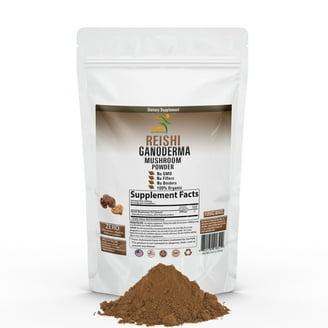
Reishi mushroom powder is dried reishi, either fruiting body or mycelium, ground to a fine particle size. It is not concentrated.
Typical traits:
- Contains the whole matrix, including fiber and chitin.
- Low processing cost.
- Variable active content from batch to batch.
- Earthy, bitter flavor.
What Is Reishi Mushroom Extract?
Reishi mushroom extract is made by extracting the mushroom with hot water, alcohol, or both. The extract is then concentrated and dried. Extraction is designed to release compounds from the tough cell wall and concentrate them.
For reishi, a dual extraction (water plus alcohol) is generally recommended. It captures both water-soluble polysaccharides and alcohol-soluble triterpenoids.
Digestibility and Bioavailability
This is the most important scientific difference.
- Mushroom cell walls are made of chitin, which the human gut breaks down only to a limited degree.
- In raw ground powder, much of the beta-glucan stays locked inside the cell wall.
- Heat and extraction break down chitin and release the actives.
- Reviews of reishi spore powder show the same principle. The hard chitin-and-cellulose shells hinder absorption, so wall-breaking is used to release polysaccharides and triterpenes.
Some vendor sources claim extracts are "up to 10x" more potent than powder. I treat that figure as a marketing claim, not a settled scientific number. The mechanism is sound, but the exact multiple depends on the extraction method and the raw material.
Extract vs. Powder: Side-by-Side
| Factor | Reishi Extract | Reishi Powder |
| Active concentration | High, standardizable | Low, variable |
| Bioavailability | Higher (cell wall disrupted) | Lower (chitin barrier) |
| Typical beta-glucan benchmark | ≥20% for an extract | ≥10% for fruiting body |
| Dose per serving | Small (capsule-friendly) | Large (bulky) |
| Taste | Milder per dose | Strong, bitter |
| Cost per kg | Higher | Lower |
| Cost per active dose | Often competitive | Can be higher |
| Best formats | Capsules, tablets, gummies, drinks | Functional foods, blends, whole-food products |
| Label claims | Easier to support | Harder to support |
Quality Standards That Separate Good From Bad
The benchmarks below come from independent testing criteria.
1. Use beta-glucan, not "total polysaccharides."
ConsumerLab's criteria require fruiting-body products to provide 1,3:1,6-beta-D-glucans at no less than 10% of the listed amount, or 20% if an extract. Mycelium powder needs at least 1%. Quality testing now favors the Megazyme beta-glucan method over older polysaccharide assays.
2. Expect big variation between products.
ConsumerLab tested reishi products. It found 1,3-beta-D-glucan ranging from 5.6 to 264.5 mg per serving and ganoderic acids from 2.6 to 70.2 mg.
3. Test heavy metals on every lot.
Reishi can accumulate cadmium and arsenic from its substrate. Mainstream guidance also recommends third-party testing. Standard testing covers lead, cadmium, arsenic and mercury by ICP-MS.
4. Check identity.
Chemical fingerprinting (HPTLC) confirms the right species and plant part.
Expert Insight: What I See in Formulation Practice
*(Practitioner perspective. Adapt it with your own R&D data before publishing.)*
- Capsule and tablet brands almost always choose extract. The dose is small and the label can state a standardized beta-glucan level.
- Powder works in smoothies, coffee blends or baked goods. The consumer expects a whole-food product and accepts the taste.
- Hybrid formulas are growing. A small amount of powder adds "whole mushroom" appeal, and extract supplies the standardized actives.
- Industry standards are still maturing. One review notes that the lack of unified chromatographic and characterization standards means polysaccharide structures can differ even from the same raw material and method. Always ask for a COA and the method used.
Safety and Regulatory Notes
- Reishi is not for everyone. Products should carry appropriate cautions, and consumers on medication should consult a professional.
- Some vendor blogs argue that extracts are the lower-risk option because they are standardized and contaminant-tested, while raw powder brings chitin and variable compounds. This is not a clinical conclusion. The real safeguard is batch testing for contaminants and potency.
- Mayo Clinic's press material notes that human research on mushroom supplements is still limited. Keep your claims within structure/function limits and your local regulations.
Practical Steps: How to Choose for Your Product
1. Define the claim. Do you need a standardized beta-glucan or triterpene level? If yes, choose extract.
2. Set the dose and format. Capsules and gummies favor extract.
3. Set the cost target. Compare cost per milligram of beta-glucan, not per kilogram.
4. Choose the extraction type. Dual extraction gives the fullest profile.
5. Request documents. Ask for a COA with beta-glucan (Megazyme), heavy metals, microbiology and identity.
6. Run a pilot batch. Check solubility, flavor and flow properties.
Which Is Better for Your Supplement?
- Choose extract if you make capsules, tablets, gummies or drinks, and you want standardized, bioavailable actives.
- Choose powder if you make foods or blends with a whole-food story and a tight cost ceiling.
- Choose a hybrid if you want both.
FAQ
1. Is reishi extract better than reishi powder?
For supplements that need a standardized, bioavailable dose, yes. Extraction releases actives from chitin cell walls, and an extract can reach higher beta-glucan levels (≥20% benchmark vs. ≥10% for fruiting-body powder).
2. Why is chitin important?
Chitin forms the cell wall and traps beta-glucans. Humans digest it only marginally, so raw powder releases fewer actives.
3. What is dual extraction?
Hot-water extraction pulls out polysaccharides, and alcohol extraction pulls out triterpenes. Using both captures a fuller profile.
4. How can I verify reishi quality?
Request a COA showing beta-glucan by Megazyme assay, heavy metals by ICP-MS, and identity testing.
5. Does reishi contain heavy metals?
It can accumulate cadmium and arsenic from its growing substrate, so lot-by-lot testing is essential.
6. Is reishi powder ever the right choice?
Yes. It suits functional foods and whole-food-style products where cost and positioning matter more than standardization.
7. Are all reishi products equal?
No. Tested products varied from 5.6 to 264.5 mg of beta-glucan per serving.
References
1. [A Review of Ganoderma lucidum Polysaccharide (PMC, 2024)]
2. [ConsumerLab – Reishi supplement testing methods]
3. [Amritatva – Mushroom powder vs supplements]
4. [Triterra Farm – Powder, capsules or tincture]
5. [Prodigy Labs – Mushroom supplement testing]
6. [Bioactive Components and Pharmacological Effects of Ganoderma (Food Sci Nutr, 2025)]
7. [YourHealthier – Reishi and liver safety]
8. [Quality consistency of G. lucidum dietary supplements (PMC, 2017)]
9. [Bioactivities and industrial standardization of G. lucidum (PMC, 2024)]
10. [Mayo Clinic Press – Do mushroom supplements work?]
11. [Medicinal Mushrooms: Bioactive Components and Nutritional Value (PMC, 2023)]
12. [MycoGenius – Mushroom extract bioavailability]
13. [ConsumerLab – Best reishi supplements (2019)]
14. [Real Mushrooms – Quality assurance]