Standardized botanical extracts are plant-derived ingredients controlled to meet defined specifications for selected compounds or other measurable characteristics. For buyers, standardization provides a way to evaluate ingredient composition and compare batches against agreed requirements.
These extracts are used in dietary supplements, functional foods, beverages, and other applications where defined ingredient characteristics matter. However, standardization alone does not establish botanical identity, purity, clinical effectiveness, or suitability for a particular formulation.
To evaluate standardized herbal extracts properly, buyers need to review marker specifications, analytical methods, batch results, manufacturing controls, and application requirements together.
This guide explains how botanical extract standardization works and what to check before selecting an ingredient or approving a supplier.
1. What Are Standardized Botanical Extracts?
Standardized botanical extracts are manufactured or controlled to meet a defined specification for one or more selected constituents, marker compounds, or other measurable characteristics.
Depending on the ingredient, a specification may define:
· A target marker content.
· A minimum content requirement.
· An acceptable concentration range.
· Another measurable quality parameter.
For example, certain ginseng extracts are standardized for ginsenosides, while specified Tongkat Ali extracts may have an eurycomanone content requirement.
Standardization helps establish measurable purchasing requirements. It also provides a basis for assessing whether successive batches meet the same agreed specification.
However, standardization is not the same as comprehensive quality control. A standardized extract still requires appropriate evaluation of botanical identity, contaminants, physical properties, and other characteristics relevant to its intended use.
2. What Are Marker Compounds?
Marker compounds are selected constituents used to characterize a botanical ingredient or support identification, specification, and quality assessment.
Terminology varies between ingredients and analytical standards. A specification may refer to active constituents, analytical markers, characteristic compounds, or groups of related compounds. These terms should not automatically be treated as interchangeable.
In particular, the term “active marker” should not be interpreted as proof that the measured compound accounts for all of an extract’s biological activity.
Examples of Botanical Extract Markers
Botanical ingredient | Example marker or compound group | What buyers should clarify |
Ginseng | Ginsenosides | Which individual compounds are included in the reported total |
Tongkat Ali | Eurycomanone | The content requirement and analytical method |
Green tea | EGCG | Whether the specification measures EGCG separately from total catechins |
Ginger | Gingerols | Which compounds are included in the assay |
Ashwagandha | Withanolides | How the compound group is defined and measured |
These examples describe markers used in selected extracts, not universal specifications for every product made from each botanical.
A marker’s presence or concentration does not, by itself, establish the overall quality or clinical effectiveness of an extract. Buyers should confirm exactly what is measured, how it is measured, and how the result is reported.
3. How Does Botanical Extract Standardization Work?
Botanical extract standardization combines defined product specifications, manufacturing controls, and analytical testing. The precise approach varies by botanical and extract type.
Step 1: Define the Product Specification
The specification establishes the ingredient’s identity and required characteristics. Relevant details may include:
· Botanical species and plant part.
· Extract form.
· Selected marker compounds.
· Target content or acceptable range.
· Analytical methods.
· Physical and contaminant requirements.
The specification should reflect the ingredient’s intended application rather than relying only on a commercially familiar percentage.
Step 2: Select Suitable Raw Materials
Botanical species, plant part, sourcing conditions, storage, and raw material quality can influence the composition of the finished extract.
Raw material identification and incoming quality checks help establish a suitable starting point for processing.
Step 3: Control Extraction and Processing
Extraction solvent, processing conditions, concentration, and drying can affect the resulting composition and physical characteristics.
Manufacturing controls help achieve the intended product profile, although the specific controls depend on the ingredient and production method.
Step 4: Test the Extract
Appropriate analytical methods measure the specified marker compounds and other required parameters.
The method must be suitable for both the compound being measured and the botanical matrix. Results are then interpreted against the applicable specification.
Step 5: Review and Release the Batch
Finished material is assessed against established acceptance criteria. Relevant results are recorded in batch documentation, including the Certificate of Analysis where applicable.
Standardization therefore involves more than placing a percentage on a product label. It requires a defined specification, controlled production, and reliable analytical evidence.
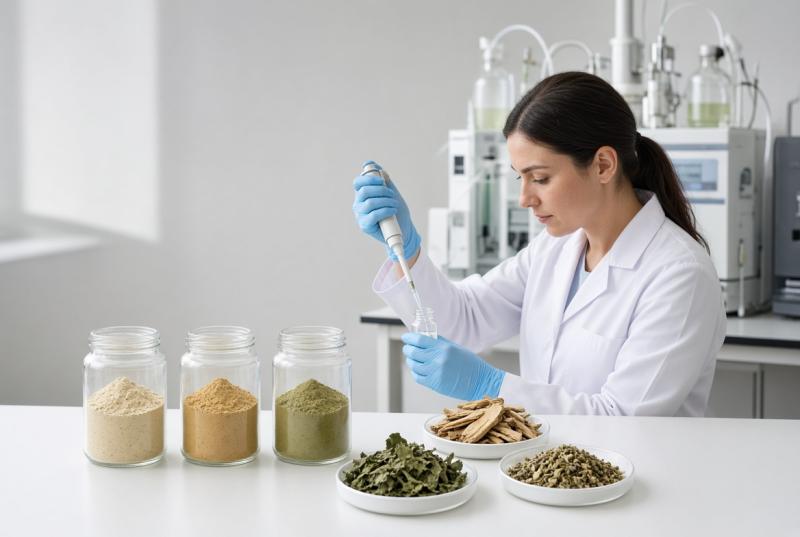
4. Extract Ratio vs. Standardized Marker Content
Extract ratio and standardized marker content describe different characteristics of a botanical extract.
An extract ratio describes the relationship between the quantity of starting botanical material and the quantity of resulting extract, according to a stated basis.
Standardized marker content describes the specified amount of a selected compound or compound group, usually expressed as a percentage or another defined unit.
Illustrative Comparison
Parameter | Extract A | Extract B |
Stated extract ratio | 10:1 | 20:1 |
Marker specification | 2% | 2% |
Marker analytical method | Must be specified | Must be specified |
Reporting basis | Must be clarified | Must be clarified |
Other quality parameters | Require evaluation | Require evaluation |
This comparison is illustrative and does not describe actual commercial products.
Although the stated ratios differ, both extracts have the same illustrative marker specification. The ratio alone does not establish which product has a higher marker concentration, better quality, or greater suitability for a formulation.
Likewise, two extracts with the same ratio may differ in marker content, broader composition, physical properties, and quality controls.
When comparing products, ask the supplier to explain the basis of both the extract ratio and the marker percentage.
5. Which Analytical Methods Measure Botanical Marker Compounds?
The appropriate analytical method depends on the compound, botanical matrix, required sensitivity, and purpose of testing.
High-Performance Liquid Chromatography — HPLC
HPLC separates compounds in complex mixtures and can support the measurement of selected botanical markers. Detection may use ultraviolet or other suitable detectors, depending on the method.
Ultra-High-Performance Liquid Chromatography — UHPLC
UHPLC provides efficient chromatographic separation and can be used for botanical compound analysis when the method is suitable for the intended measurement.
Liquid Chromatography–Mass Spectrometry — LC-MS
LC-MS combines chromatographic separation with mass spectrometric detection. It can support compound identification and quantification when additional selectivity or sensitivity is needed.
Spectrophotometric Methods
Spectrophotometric methods may be used for certain defined assays, including group-based measurements.
However, a result reported as “total” compound content may not be directly comparable with a result obtained through compound-specific chromatography.
Why the Method Matters
A method name on a specification sheet does not establish that the method is suitable for every extract.
For important comparisons, buyers should clarify:
· Which compounds the method measures.
· Whether the method is suitable for the extract.
· Which reference standards are used.
· How samples are prepared.
· How results are calculated and reported.
· What validation or verification supports the measurement.
Two products showing the same percentage may not be analytically equivalent if their methods or reporting conventions differ.
6. How to Read a Botanical Extract Certificate of Analysis
A Certificate of Analysis, or COA, reports results for a specified product batch. It helps buyers assess whether the tested material meets the applicable specification.
Key COA Information to Review
COA item | What buyers should check |
Product identification | Product name, code, botanical identity, and extract description |
Batch or lot number | Whether the document matches the material being supplied |
Test parameters | Whether the listed tests address the intended application |
Specification limits | Acceptance criteria and measurement units |
Analytical results | Reported values and their relationship to the limits |
Analytical methods | Methods used for markers and other critical parameters |
Document date and authorization | Issue date and relevant approval information |
Contaminant testing | Applicable heavy metal, microbiological, pesticide, and residual solvent results |
For quantitative parameters such as marker content, review the numerical result where available rather than relying only on a general “pass” statement. Qualitative tests may appropriately use other reporting formats.
A COA does not necessarily address every quality attribute or regulatory requirement. Buyers should confirm that its scope is appropriate for the product, batch, application, and destination market.
7. Does Higher Marker Content Mean Better Quality?
Not necessarily. A higher standardized marker percentage describes one aspect of an ingredient, not its overall quality.
A meaningful assessment also considers:
· Correct botanical identity.
· The definition of the measured marker.
· Analytical method suitability.
· The broader composition of the extract.
· Relevant contaminant limits.
· Physical properties and formulation compatibility.
· Batch-to-batch consistency.
· Documentation and traceability.
A higher-content extract may suit one project but be less suitable for another because of solubility, sensory characteristics, processing requirements, or cost.
The purchasing objective should be to obtain the right specification for the intended product—not simply the highest available percentage.
8. What Affects Batch-to-Batch Consistency?
Botanical extracts originate from biological materials, so controlling variability is an important part of ingredient evaluation.
Raw Material Variation
Species, plant part, growing conditions, harvest timing, storage, and raw material quality can influence the composition of the starting material.
Extraction and Processing
Solvent selection, extraction conditions, concentration, and drying can affect the composition and properties of the finished extract.
Analytical Variation
Methods, reference standards, sample preparation, and reporting conventions can produce results that are not directly comparable.
Specification and Quality Controls
Defined acceptance criteria, appropriate testing, process controls, and traceability support consistent batch evaluation.
For ongoing supply programs, buyers should ask whether successive batches are assessed against the same agreed specification and how relevant changes are communicated.
9. Consider Application Requirements Before Selecting an Extract
A standardized botanical extract should meet the requirements of the finished product, not only its marker-content target.
Product Format and Processing
Evaluate the extract in relation to the intended format, such as capsules, tablets, powders, foods, or beverages.
Relevant considerations may include solubility, dispersibility, physical properties, and compatibility with the proposed manufacturing process.
Sensory Requirements
Taste, color, and odor may influence whether an extract is appropriate for a particular formulation, especially when it is used in a food or beverage.
These characteristics should be considered alongside the marker specification.
Composition and Supporting Ingredients
Clarify the composition of the supplied material, including any declared carriers or other ingredients. This helps buyers understand what the specification describes and whether the material fits the proposed formulation.
Destination-Market Requirements
Do not assume that a standardized marker specification establishes suitability for every market or application.
Confirm the requirements relevant to the ingredient, intended use, and destination market as part of the overall product review.
Commercial Fit
Assess whether the supplier can support the required specification, documentation, batch consistency, and purchasing needs over time.
A successful sourcing decision brings together analytical suitability, formulation performance, and dependable supply.
10. Buyer’s Checklist for Standardized Botanical Extracts
Before approving a product or supplier, use the following checklist to identify missing information.
Evaluation area | Questions to ask |
Botanical identity | What species and plant part are used? How is identity assessed? |
Extract description | What extract form is supplied, and how is its composition described? |
Standardization | Which compound or compound group is specified? |
Content requirement | Is the value a minimum, target, or acceptable range? |
Reporting basis | How is the reported percentage defined? |
Analytical method | Is the method suitable for the marker and botanical matrix? |
Extract ratio | How is the ratio calculated and defined? |
Batch documentation | Does the COA correspond to the supplied lot? |
Contaminant controls | Which relevant contaminants are tested, and against what limits? |
Application suitability | Does the extract meet formulation and processing requirements? |
Consistency | Are successive batches evaluated against the same specification? |
Change communication | How are specification or manufacturing changes communicated? |
Resolve unclear specifications before comparing prices or approving commercial purchases. A quotation is more useful when the products being compared have clearly defined and comparable characteristics.
Frequently Asked Questions
What does “standardized botanical extract” mean?
It means a botanical extract is manufactured or controlled to meet a defined specification for selected constituents, marker compounds, or other measurable characteristics. It does not mean that every component of the extract is present at a fixed concentration.
Are standardized botanical extracts better than non-standardized extracts?
Not automatically. Standardization provides a defined basis for assessing selected characteristics, but suitability still depends on botanical identity, overall quality, composition, and intended use.
Is a 20:1 extract stronger than a 10:1 extract?
The ratio alone cannot establish that. It describes a raw-material-to-extract relationship according to a stated basis, not necessarily the concentration of a particular marker compound.
Can two extracts with the same marker percentage be different?
Yes. They may differ in botanical identity, plant part, broader composition, analytical methods, physical properties, and other quality parameters. The percentage must be interpreted within the complete specification.
Does standardized marker content prove clinical effectiveness?
No. A marker percentage alone does not establish clinical effectiveness. It is a specification characteristic and should not be treated as proof of a health outcome.
What documents should buyers review?
Start with the product specification and a batch-specific COA. Depending on the project, additional information may be needed to assess botanical identity, analytical methods, traceability, manufacturing controls, and application suitability.
Can a COA replace supplier qualification?
No. A COA provides information about a specified batch, but supplier evaluation also involves reviewing the controls and documentation that support consistent production and reliable results.
Standardized botanical extracts give buyers a measurable basis for defining selected ingredient characteristics and reviewing batch results. Their value depends on how clearly the specification is defined and how reliably it is supported by manufacturing controls and analytical testing.
For a sound purchasing decision, evaluate marker content alongside botanical identity, method suitability, contaminants, physical properties, traceability, and application requirements. The most suitable extract is the one that meets the complete project specification—not necessarily the one with the highest percentage or extract ratio.