Content Menu
● From Single Ingredients to Multi-Component Systems
● Flavor Architecture in Modern R&D
● How Umami Supports Sodium Reduction
● The Role of Fermentation in Flavor Development
● Why Application-Specific Design Matters
● Technical Outlook
● About Botaniex
As the food industry moves toward clean label, sodium reduction, and plant-based innovation, traditional flavor enhancement strategies are becoming less effective. Modern R&D teams are now focused on building natural umami systems that can deliver both sensory performance and label transparency.
This technical shift is changing how savory food products are formulated. Instead of relying on a single ingredient to create taste impact, manufacturers are now designing integrated systems that deliver layered flavor, improved mouthfeel, and longer-lasting sensory satisfaction.
For food developers, natural umami is not just a marketing term. It is a formulation strategy.
From Single Ingredients to Multi-Component Systems
In the past, monosodium glutamate was widely used because it offered a fast and efficient way to enhance umami taste. However, the needs of today’s market are much more complex.
Consumers now expect products that taste good and also support clean label positioning. That means R&D teams must create systems that combine several ingredients, each contributing a specific sensory role.
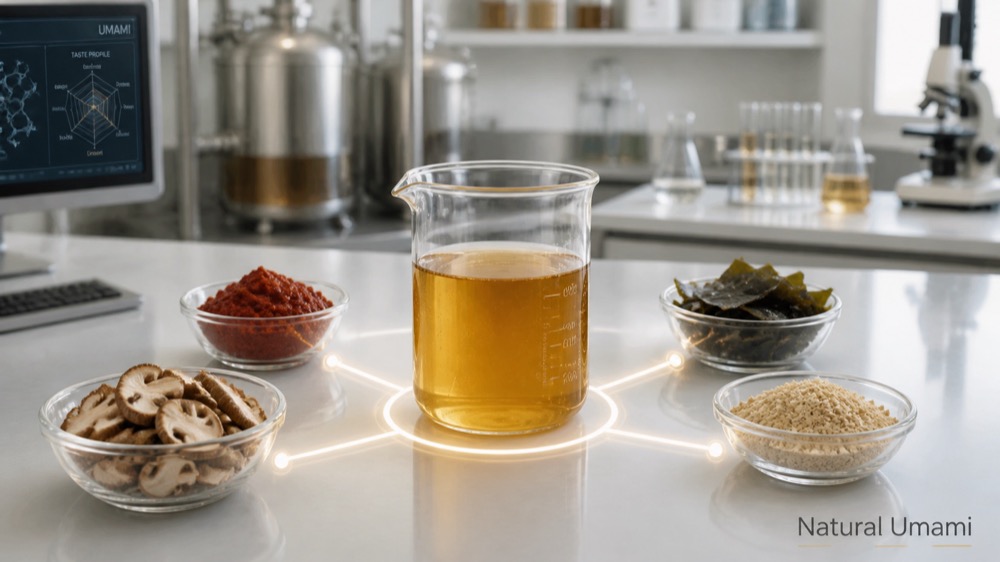
Mushroom extract may provide depth and body. Yeast extract may deliver immediate savory impact. Tomato concentrate may increase natural glutamate richness. Seaweed extract may add soft marine umami. Fermented plant extracts may contribute complexity and lingering taste.
The objective is not simply to increase intensity. It is to design a balanced and layered taste experience that performs consistently across applications.
Flavor Architecture in Modern R&D
A successful savory product is usually built around three major flavor phases.
The first phase is front-end flavor release, which defines the initial taste impression. The second phase is mid-palate body and mouthfeel, which shapes the product’s sensory richness. The third phase is aftertaste complexity, which determines how long the flavor remains on the palate.
Natural umami systems are particularly useful in this framework because different ingredients can contribute to different stages of flavor perception. By combining ingredients strategically, R&D teams can create a more complete and satisfying sensory profile.
This approach is especially valuable in soups, sauces, seasoning blends, instant noodles, plant-based proteins, and ready meals.
How Umami Supports Sodium Reduction
One of the biggest technical challenges in food formulation today is reducing sodium without losing flavor.
Salt reduction can easily create blandness, weak flavor delivery, and lower consumer acceptance. Natural umami systems help address this by enhancing salt perception and overall flavor fullness. In many cases, they allow formulators to reduce sodium chloride while preserving the taste experience.
This functional benefit is especially important in processed foods, where sodium plays a major role in taste stability. By using umami strategically, manufacturers can improve nutritional profiles without compromising product performance.
For R&D teams, this makes umami one of the most practical tools in modern reformulation.
The Role of Fermentation in Flavor Development
Fermentation is becoming a key technology in the development of natural savory systems.
Fermented ingredients can deliver natural flavor complexity, improved amino acid profiles, and stronger sensory depth. They also support clean label narratives that resonate with health-conscious consumers.
Emerging areas of innovation include fermented mushroom extracts, yeast-based savory systems, fermented soy ingredients, and precision fermentation platforms. These technologies are enabling more customized and more consistent flavor solutions.
For manufacturers, fermentation offers a way to combine tradition, science, and market relevance in one system.
Why Application-Specific Design Matters
There is no universal solution for umami formulation. Every product category has different processing conditions, target markets, and sensory expectations.
A system that works well in a soup base may not perform the same way in a snack seasoning or plant-based meat product. That is why customization is essential. R&D teams must consider heat stability, flavor release, ingredient compatibility, cost structure, and regional taste preferences.
The best results come from application-specific design rather than generic ingredient substitution. This is where technical expertise becomes a competitive advantage.
Technical Outlook
Natural umami systems are becoming a core part of savory food innovation. They support clean label positioning, sodium reduction, enhanced sensory performance, and better product differentiation.
As the industry continues to evolve, the most successful companies will be those that treat flavor as a system rather than a single ingredient. The future of savory formulation will depend on technical precision, sensory science, and natural ingredient innovation.
About Botaniex
Botaniex is a market-oriented and research-driven manufacturer and supplier of natural ingredients, specializing in botanical extracts and functional herbal formulations for the dietary supplement, functional food, functional beverage, cosmetics, and pharmaceutical industries. Botaniex is committed to innovation, quality, and customized natural solutions that support product development and application performance.