Content Menu
● Cyanotis Arachnoides Extract vs. Magnolia Bark Extract: At a Glance
● What Is Cyanotis Arachnoides Extract?
>> What Does Human Ecdysterone Research Show?
● What Is Magnolia Bark Extract?
>> What Does the Cortisol Research Actually Show?
● Protein Digestion vs. Protein Synthesis: The Critical Difference
>> Does Cyanotis Arachnoides Extract Improve Protein Digestion?
>> Does Magnolia Bark Extract Improve Protein Digestion?
● Which Extract Is Better for Male Hormonal Health?
>> For Muscle-Focused Product Development
>> For Stress-Oriented Wellness Products
>> For Protein Digestion Products
● Industry Insight: The Evidence-Transfer Gap
● A Practical Ingredient-Qualification Checklist
● A Better Research Plan for Protein Digestion Claims
>> Stage 1: Establish Finished-Product Identity
>> Stage 2: Investigate Digestion Directly
>> Stage 3: Test Relevant Human Outcomes
● Safety and Responsible Product Positioning
● Choosing an Ingredient Partner: A Targeted Next Step
● Frequently Asked Questions
>> 1. Is Cyanotis Arachnoides Extract Better Than Magnolia Bark Extract for Testosterone?
>> 2. Does Ecdysterone Improve Protein Digestion?
>> 3. Can Magnolia Bark Extract Reduce Cortisol?
>> 4. Can the Two Extracts Be Combined?
>> 5. Does Magnolia's Digestive Research Prove Better Protein Absorption?
>> 6. What Should Buyers Ask a Botanical Ingredient Supplier?
Comparing Cyanotis arachnoides extract vs. Magnolia bark extract for male hormonal health requires separating three different goals: hormonal function, muscle development, and protein digestion. These goals often appear together in supplement marketing, but evidence for one does not establish the others.
The practical answer is straightforward: neither extract has demonstrated superiority for improving testosterone or human protein digestion in the research discussed here. Ecdysterone-containing supplements have preliminary human evidence related to resistance-training outcomes. Magnolia-containing formulations have limited human evidence related to stress and cortisol. Neither finding establishes a treatment for male hormonal disorders.
For ingredient buyers and formulators, the better question is therefore not "Which botanical is stronger?" It is "Which ingredient best matches the intended outcome, studied preparation, and defensible product claim?"
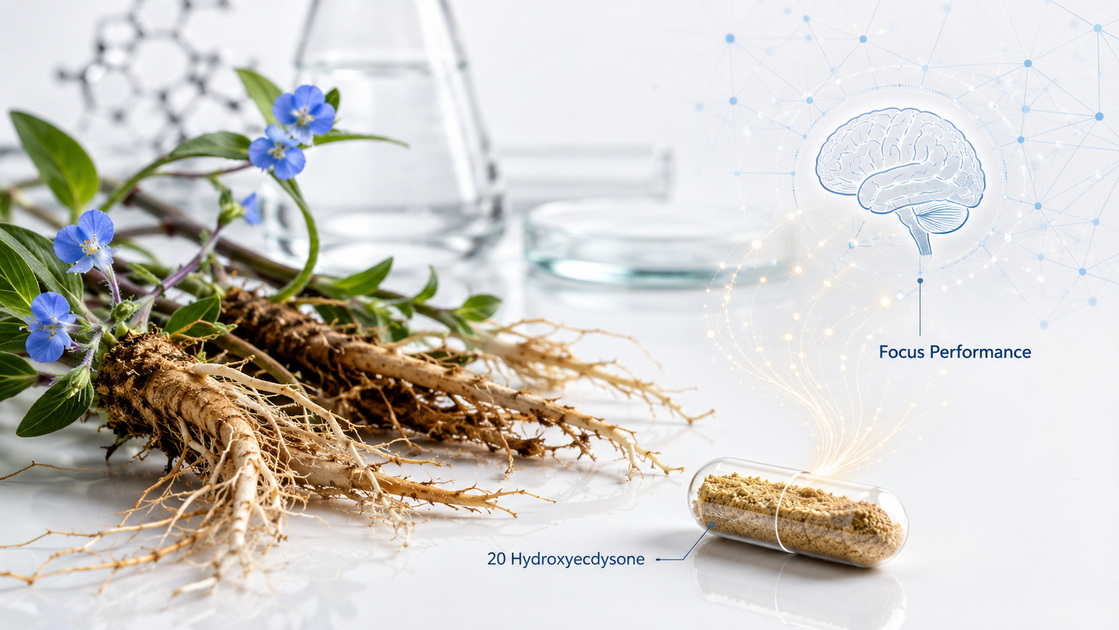
Cyanotis Arachnoides Extract vs. Magnolia Bark Extract: At a Glance
| Comparison point | Cyanotis arachnoides extract | Magnolia bark extract |
| Research focus | Phytoecdysteroids, particularly ecdysterone | Magnolia constituents and magnolia-containing formulations |
| Most relevant human evidence here | A small resistance-training study using an ecdysterone-containing supplement | A short trial using magnolia combined with Phellodendron |
| Protein digestion evidence | No demonstrated human benefit in the cited evidence | No demonstrated human benefit in the cited evidence |
| Testosterone positioning | Muscle findings do not establish testosterone enhancement | Cortisol findings do not establish testosterone enhancement |
| Main evidence limitation | Results cannot automatically transfer to every botanical extract | Combination-product results cannot isolate magnolia's contribution |
The distinction between ingredient identity and finished-product evidence is essential. An extract with a similar ingredient name is not necessarily equivalent to the preparation used in a clinical trial.
What Is Cyanotis Arachnoides Extract?
Research on *Cyanotis arachnoidea*—a name buyers may encounter alongside the commercial wording Cyanotis arachnoides—has investigated extracts containing phytoecdysteroids. Ingredient qualification should establish the authenticated botanical identity rather than assume commercial names are interchangeable.
For sports-nutrition discussions, the compound attracting particular attention is ecdysterone.
What Does Human Ecdysterone Research Show?
A 2019 study followed 46 young men through a 10-week resistance-training intervention. Participants receiving ecdysterone-containing supplements showed greater increases in muscle mass, and the researchers reported greater improvements in one-repetition bench-press performance. Liver and kidney toxicity biomarkers did not increase during the intervention.
These findings are interesting, but their scope matters:
- The study investigated training outcomes, not treatment of low testosterone.
- It did not establish improved dietary protein digestion.
- Short-term biomarker findings do not establish long-term safety.
- The results do not validate every Cyanotis extract or commercial specification.
My assessment of this evidence is that ecdysterone deserves further investigation for muscle-related applications. Calling it a proven male hormone optimizer would go beyond what this study demonstrates. [hero.epa]
What Is Magnolia Bark Extract?
Magnolia bark research commonly concerns *Magnolia officinalis*. Its major investigated constituents include honokiol and magnolol. Published work covers digestive, nervous-system, and other biological activities, but these research areas contain different levels of evidence.
For male wellness positioning, stress-related research is more relevant than claims about directly increasing testosterone.
What Does the Cortisol Research Actually Show?
A randomized, placebo-controlled study examined 56 moderately stressed adults, including 35 men and 21 women, over four weeks. Participants received either placebo or Relora, a proprietary combination of Magnolia officinalis and Phellodendron amurense extracts.
The combination group had 18% lower salivary cortisol exposure than placebo and improvements in several mood measures.
However, the study does not establish that:
- Magnolia bark alone produces the same result.
- Any magnolia extract is equivalent to the tested formulation.
- Lower cortisol exposure necessarily increases testosterone.
- The formulation improves protein digestion.
Results are also not completely consistent across trials. An earlier study of a proprietary magnolia–Phellodendron preparation did not find significant changes in salivary cortisol or sleep quality compared with placebo. That makes universal "cortisol-lowering" claims inappropriate.
Protein Digestion vs. Protein Synthesis: The Critical Difference
The most important distinction in this comparison is protein digestion versus protein synthesis.
Protein digestion breaks dietary proteins into smaller components that the body can absorb. Stomach acid, digestive enzymes, pancreatic secretions, and small-intestinal processes participate in this breakdown. Amino acids then enter circulation and become available for growth and repair.
Muscle-building research concerns a different stage: what tissues do with available nutrients.
An ingredient associated with muscle growth has not automatically been shown to improve the digestion of a protein shake or increase amino-acid absorption.
Does Cyanotis Arachnoides Extract Improve Protein Digestion?
The cited evidence does not demonstrate this benefit in humans.
A study of phytoecdysteroids extracted from Cyanotis arachnoidea examined rumen fermentation and digestibility. Crude-protein digestibility did not change. This was not a human digestion study, so it cannot support a claim that Cyanotis extract helps men digest dietary protein more efficiently.
The human ecdysterone trial measured muscle and performance outcomes, not protein digestibility. Combining these separate findings into a "better protein absorption" claim would misrepresent the evidence.
Does Magnolia Bark Extract Improve Protein Digestion?
Magnolia has a history of gastrointestinal use, and experimental studies have investigated intestinal inflammation and barrier function. For example, a mouse colitis study found effects on intestinal-cell injury, with additional laboratory work involving honokiol and magnolol.
However, intestinal barrier findings are not measurements of protein digestion.
They do not demonstrate that magnolia bark increases digestive-enzyme activity, improves amino-acid absorption, or helps healthy men obtain more usable protein from meals. For a protein-digestion product, neither botanical currently has a clear evidence-based advantage from the sources reviewed.
Which Extract Is Better for Male Hormonal Health?
There is no established winner for directly improving male hormonal health.
The available studies address different outcomes:
- Ecdysterone research offers a preliminary muscle-performance signal.
- Magnolia-containing formulation research offers a limited stress-related signal.
- Neither establishes treatment efficacy for testosterone deficiency or another male endocrine disorder.
For Muscle-Focused Product Development
Ecdysterone is the more relevant research lead because the cited human trial directly assessed resistance-training adaptations. That relevance should not be confused with proof of testosterone enhancement or improved digestion.
For Stress-Oriented Wellness Products
Magnolia-containing formulations have more directly relevant human stress research. Nevertheless, formulation composition matters, and a supplier should not present a combination-product trial as proof for an unrelated magnolia-only ingredient.
For Protein Digestion Products
Neither ingredient should be selected primarily on the strength of muscle-growth findings, traditional digestive use, or speculative mechanisms. A digestion claim requires evidence that actually measures digestion or absorption.
This endpoint-based approach creates a more credible product story than grouping every benefit under "male hormonal balance."
Industry Insight: The Evidence-Transfer Gap
One of the most overlooked problems in botanical marketing is the evidence-transfer gap: a study investigates one preparation, while marketing promotes another.
Consider two hypothetical development briefs.
A sports-nutrition brand finds the ecdysterone training study and requests a Cyanotis extract. Before adopting its conclusions, the brand should compare the research preparation with the proposed ingredient's composition and delivered amount.
A stress-support brand finds the Relora trial and requests magnolia bark extract alone. The study cannot establish that the single ingredient reproduces the combination's effects.
These are illustrative scenarios, not documented Botaniex customer cases.
My formulation-selection principle is simple: the closer the commercial ingredient matches the studied preparation, population, and outcome, the more useful the evidence becomes.
A Practical Ingredient-Qualification Checklist
For a manufacturer such as Botaniex, the supplied company background makes botanical identification, extraction expertise, and customized formulation development relevant commercial themes. However, those capabilities should be supported by product-specific documentation rather than assumed from a general company description.
Before selecting either extract, use this proposed qualification workflow:
1. Confirm identity. Request the botanical name, plant part, origin, and identity-testing approach.
2. Define composition. Specify ecdysterone content or the relevant magnolia constituent profile.
3. Review the assay. Ask how the marker concentration is measured and reported.
4. Compare research relevance. Check preparation, serving amount, population, duration, and endpoints.
5. Review quality documentation. Request applicable contaminant, microbiological, and residual-solvent results.
6. Test the finished format. Evaluate stability, sensory properties, dispersion, and serving feasibility.
7. Review the intended claim. Separate what the product contains from what evidence shows it can do.
This checklist is a proposed procurement framework, not a claim that either ingredient—or Botaniex—already meets a particular certification or testing standard.
A Better Research Plan for Protein Digestion Claims
A distinctive product needs evidence matched to its promise.
For a formula intended to improve protein digestion, I would propose a staged validation plan:
Stage 1: Establish Finished-Product Identity
Document the exact extract, constituent profile, serving amount, and complete formula. A study cannot meaningfully validate a product whose composition remains undefined.
Stage 2: Investigate Digestion Directly
Use suitable digestion models to explore protein breakdown. Treat laboratory findings as screening evidence, not proof of consumer benefit.
Stage 3: Test Relevant Human Outcomes
Design an appropriately controlled human study measuring prespecified outcomes relevant to digestion or amino-acid availability.
Do not substitute bench-press strength, salivary cortisol, or general digestive comfort for a direct protein-digestion endpoint. These measure different biological questions.
Safety and Responsible Product Positioning
The absence of increased liver or kidney toxicity biomarkers in a 10-week ecdysterone trial is reassuring within that study, but it does not establish indefinite safety for all extracts, doses, or users.
Similarly, short magnolia-combination trials cannot establish the long-term safety or efficacy of every magnolia product.
A responsible article should avoid presenting either extract as a substitute for clinical assessment of suspected hormonal disease. Product-specific safety review should precede recommendations, particularly when a finished formula includes multiple active ingredients.
No universal dose is proposed here because the evidence does not establish an interchangeable dose across these botanical preparations.
Choosing an Ingredient Partner: A Targeted Next Step
For Botaniex, the strongest commercial message is not "one botanical solves everything." It is helping customers connect ingredient specifications with realistic development goals.
Contact Botaniex with your intended application, target market, delivery format, and proposed benefit. Request product-specific specifications, available quality documentation, samples, and a discussion of how closely the proposed ingredient matches relevant research.
For muscle-oriented development, examine the ecdysterone evidence carefully. For stress-oriented concepts, distinguish magnolia-only ingredients from studied combinations. For protein digestion, prioritize direct validation rather than borrowing claims from unrelated endpoints.

Frequently Asked Questions
1. Is Cyanotis Arachnoides Extract Better Than Magnolia Bark Extract for Testosterone?
Neither has demonstrated superiority for testosterone in the cited research. The main studies discussed measured resistance-training outcomes or stress-related outcomes, not treatment of testosterone deficiency. [hero.epa]
2. Does Ecdysterone Improve Protein Digestion?
The cited human trial does not establish that benefit. Muscle-mass and strength outcomes are not measurements of protein breakdown or amino-acid absorption. [hero.epa]
3. Can Magnolia Bark Extract Reduce Cortisol?
One four-week study found lower salivary cortisol with a magnolia–Phellodendron combination. The result should not be attributed to magnolia alone, and an earlier combination trial did not find a significant cortisol change. [pubmed.ncbi.nlm.nih]
4. Can the Two Extracts Be Combined?
The studies discussed do not establish the efficacy or safety of this specific combination. A combined product would need its own formulation rationale, safety assessment, and evidence for any advertised benefits.
5. Does Magnolia's Digestive Research Prove Better Protein Absorption?
No. Traditional gastrointestinal use and experimental intestinal-barrier findings do not demonstrate improved human protein absorption. These are different outcomes requiring different measurements. [pubmed.ncbi.nlm.nih]
6. What Should Buyers Ask a Botanical Ingredient Supplier?
Ask for authenticated identity, constituent specifications, assay methods, quality documentation, and evidence relevant to the exact preparation. Use the qualification checklist above to identify missing information before committing to a formula.
Hot Tags: China, Global, OEM, private label, manufacturers, factory, suppliers, manufacturing company